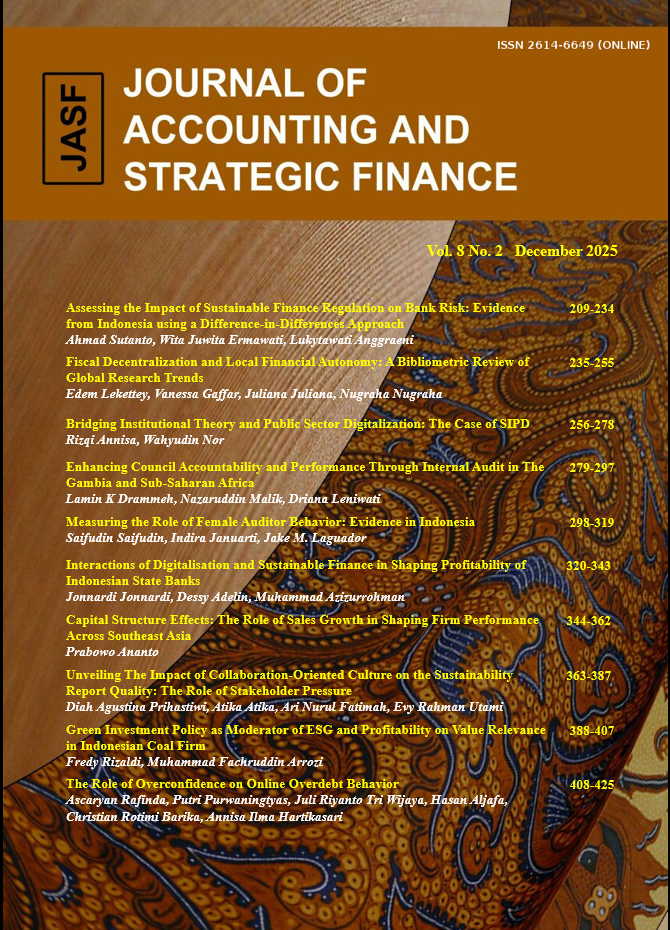
Measuring the Role of Female Auditor Behavior: Evidence in Indonesia
DOI:
https://doi.org/10.33005/jasf.v8i2.614Keywords:
female auditor, organizational culture, personalized audit communication, professional skepticismAbstract
Purpose: This research aims to further examine the factors that cause the underrepresentation of female auditors in Indonesian public accounting firms in their professional behavior.
Method: The data were collected through the implementation of experimental methods in between subjects with 2x2x2 factorial design, which involved a total of 104 participants, including partners, managers, senior staff, and junior staff, whose data were collected directly at the IAPI training in Semarang City. Data processing was then carried out using ANOVA and regression approaches.
Findings: The results show that female and male auditors exhibit equivalent levels of professional skepticism. This indicates that the professionalization and standardization of auditing create convergence in professional competencies, regardless of gender differences. However, female auditors exhibit slightly higher levels of audit communication behavior than male auditors. This is manifested in a more comprehensive disclosure of audit information and a preference for participatory communication. Female auditors exhibit higher levels of organizational culture behavior, as evidenced by a stronger awareness of the importance of organizational ethical values and a supportive work environment.
Implications: These findings suggest that public accounting firms should eliminate gender-based biases in professional recruitment and promotion, as the convergence of professional skepticism indicates that core auditing competencies are gender-neutral. Firms are encouraged to implement gender-diversity policies that move beyond representation, focusing instead on integrating the unique behavioral strengths into specialized auditor training and leadership development programs.
Novelty/Value: This study employs experimental design to integrate moral sensitivity theory and explain complex gender differences in auditing, providing practical implications for gender diversity policies and auditor training.
Downloads
References
Abdelfattah, T., Elmahgoub, M., & Elamer, A. A. (2021). Female Audit Partners and Extended Audit Reporting: UK Evidence. Journal of Business Ethics, 174(1), 177–197. https://doi.org/10.1007/s10551-020-04607-0.
Agrizzi, D., Soobaroyen, T., & Alsalloom, A. (2021). Spatiality and accounting: The case of female segregation in audit firms. Accounting, Organizations and Society, 93, 101238. https://doi.org/10.1016/j.aos.2021.101238.
Amondarain, J., Aldazabal, M. E., & Espinosa-Pike, M. (2023). Gender differences in the auditing stereotype and their influence on the intention to enter the profession. Journal of Behavioral and Experimental Finance, 37(100784), 1–10. https://doi.org/10.1016/j.jbef.2022.100784.
Amondarain, J., Barrainkua, I., & Espinosa-Pike, M. (2025). Gender diversity advantages in audit firms: differences in perceived evolution and advantages among female and male professionals. Sustainable Futures, 10(July), 1–10. https://doi.org/10.1016/j.sftr.2025.101121.
Ampofo, A., Mujtaba, B., Cavico, F., & Tindall, L. (2004). Organizational Ethical Culture: A Significant Determinant of Ethical Behavior. Journal of Business and Economics Research, 2(9), 13–24. https://nsuworks.nova.edu/hcbe_facarticles/501.
Arrami, N., & QingXiang, Y. (2021). The role of moral identity in auditor’s ethical decision making. International Journal of Research in Business and Social Science, 10(2), 157–169. https://doi.org/10.20525/ijrbs.v10i2.1051.
Baldacchino, P. J., Vassallo, J., Tabone, N., Ellul, L., & Grima, S. (2022). Communication barriers between external auditors and client/management: A Maltese perspective. European Research Studies Journal, 25(3), 441–469. https://doi.org/10.35808/ersj/3041.
Baldo, M. Del, Tiron-Tudor, A., & Faragalla, W. A. (2019). Women’s role in the accounting profession: A comparative study between Italy and Romania. Administrative Sciences, 9(1), 1–23. https://doi.org/10.3390/admsci9010002.
Bayley, B. K. (2012). Organizational Ethics Training: A Proactive Perspective. Journal for Quality and Participation, 35(2), 15–19. http://rube.asq.org/quality-participation/2012/07/career-development/organizational-ethics-training.pdf.
Biocca, F., Harms, C., & Burgoon, J. K. (2003). Toward a More Robust Theory and Measure of Social Presence: Review and Suggested Criteria. Presence: Teleoperators and Virtual Environments, 12(5), 456–480. https://doi.org/10.1162/105474603322761270.
Bogdanowicz, M. S., & Calgary, A. (1992). The Communication Audit: Information Flow and the Organization. Discourse and Writing/Rédactologie, 10(1), 10-Jan. https://doi.org/10.31468/cjsdwr.325.
Bower, G. H., & Clapper, J. P. (1993). Experimental methods in cognitive science. In The Foundations of Cognitive Science (Issue January, pp. 245–300). https://doi.org/10.7551/mitpress/3072.003.0009.
Bratianu, C. (2015). Organizational Knowledge Dynamics: Managing Knowledge Creation, Acquisition, Sharing, and Transformation. In IGI Global (Issue 1). https://doi.org/10.4018/978-1-4666-8318-1.
Carrera, N., & Mareque, M. (2023). Does gender affect qualifying decisions? Evidence from public sector audits. Journal of Business Research, 154(September 2022), 113358. https://doi.org/10.1016/j.jbusres.2022.113358.
Cheng, H., & Wang, J. (2023). What’s in store for females after breaking the glass ceiling? Evidence from the Chinese audit market. Frontiers in Psychology, 14(November), 1–12. https://doi.org/10.3389/fpsyg.2023.1321391.
Christina, L. S., & Tjaraka, H. (2018). Factors that influence auditor’s professional skepticism - evidence from audit firms in Surabaya. The 1st International Conference on Islamic Economics, Business, and Philanthropy (ICIEBP 2017), Iciebp 2017, 326–330. https://doi.org/10.5220/0007081703260330.
Ciołek, M. (2017). Professional skepticism in auditing and its characteristics. Prace Naukowe Uniwersytetu Ekonomicznego We Wrocławiu, 474, 33–40. https://doi.org/10.15611/pn.2017.474.03.
Cuijpers, P., Berking, M., Andersson, G., Quigley, L., Kleiboer, A., & Dobson, K. S. (2013). A meta-analysis of cognitive-behavioral therapy for adult depression, alone and in comparison with other treatments. Canadian Journal of Psychiatry, 58(7), 376–385. https://doi.org/10.1177/070674371305800702.
Curtis, M. B., & Payne, E. A. (2008). An examination of contextual factors and individual characteristics affecting technology implementation decisions in auditing. International Journal of Accounting Information Systems, 9(2), 104–121. https://doi.org/10.1016/j.accinf.2007.10.002.
Daft, R. L., Lengel, R. H., & Trevino, L. K. (1987). Message equivocality, media selection, and manager performance: Implications for information systems. MIS Quarterly: Management Information Systems, 11(3), 355–366. https://doi.org/10.2307/248682.
Dambrin, C., & Lambert, C. (2008). Mothering or auditing? the case of two Big Four in France. Accounting, Auditing and Accountability Journal, 21(4), 474–506. https://doi.org/10.1108/09513570810872897.
Diener, E., Wirtz, D., Biswar-Diener, R., Tov, W., Kim-Prieto, C., Choi, D., & Oishi, S. (2009). New measures of well-being. Social Indicators Research Series, 39, 101–102. https://doi.org/10.1007/978-90-481-2354-4.
Diener, E., Wirtz, D., Tov, W., Kim-Prieto, C., Choi, D. won, Oishi, S., & Biswas-Diener, R. (2010). New well-being measures: Short scales to assess flourishing and positive and negative feelings. Social Indicators Research, 97(2), 143–156. https://doi.org/10.1007/s11205-009-9493-y.
Dimitrova, J., & Sorova, A. (2016). The Role of professional skepticism in financial statement audit and its appropriate application. Journal of Economics, 1(2), 1–17. https://js.ugd.edu.mk/index.php/JE/article/view/1596.
Diya, L. (2023). The Impact of Auditor Characteristics on Professional Skepticism: The Case of Lebanon. The EUrASEANs: Journal on Global Socio-Economic Dynamics, 1(1(38)), 18–28. https://doi.org/10.35678/2539-5645.1(38).2023.18-28.
Ebirim, G. U., Asuzu, O. F., Ndubuisi, N. L., Adelekan, O. A., Ibeh, C. V., & Unigwe, I. F. (2024). Women in accounting and auditing: a Review of progress, challenges, and the path forward. Finance & Accounting Research Journal, 6(2), 98–111. https://doi.org/10.51594/farj.v6i2.782.
Eysenck, H. J. (1998). Dimensions of Personality. In Rev Reprod (Issue October). Transaction Publishers.
Ferina, I., & Pratama, D. (2023). the Effect of auditor characteristics and gender diversity on fraud detection. JRAK: Jurnal Riset Akuntansi Kontemporer, 15(2), 259–271. https://doi.org/10.23969/jrak.v15i2.8225.
Graham, J. (2013). The Role of corporate culture in business ethics. Conference: Management Challenges in the 21st Century, 388–396. https://doi.org/10.48047/intjecse/v14i6.384.
Handoko, B. L., & Widuri, R. (2017). The impact of auditor communication and due professional care on client responses to inquiries for successful audit process. Proceedings of 2016 International Conference on Information Management and Technology, ICIMTech 2016, November, 296–300. https://doi.org/10.1109/ICIMTech.2016.7930348.
Harnas, S. J., Knoop, H., Bennebroek Evertsz, F., Booij, S. H., Dekker, J., van Laarhoven, H. W. M., van der Lee, M., Meijer, E., Sharpe, L., Sprangers, M. A. G., van Straten, A., Zweegman, S., & Braamse, A. M. J. (2021). Personalized versus standard cognitive behavioral therapy for fear of cancer recurrence, depressive symptoms or cancer-related fatigue in cancer survivors: study protocol of a randomized controlled trial (MATCH-study). Trials, 22(1), 1–16. https://doi.org/10.1186/s13063-021-05657-z.
Haynes, K. (2017). Accounting as gendering and gendered: A review of 25 years of critical accounting research on gender. Critical Perspectives on Accounting, 43, 110–124. https://doi.org/10.1016/j.cpa.2016.06.004.
He, L. J., & Rivai, F. A. (2024). The effect of gender diversity on the disclosure of key audit matters: examination of dual-signature environment. Managerial Auditing Journal, 39(4), 396–418. https://doi.org/10.1108/MAJ-09-2022-3695.
Hofmann, S. G., Asmundson, G. J. G., & Beck, A. T. (2013). The Science of Cognitive Therapy. Behavior Therapy, 44(2), 199–212. https://doi.org/10.1016/j.beth.2009.01.007.
Huibers, M. J. H., Lorenzo-Luaces, L., Cuijpers, P., & Kazantzis, N. (2021). On the road to personalized psychotherapy: a research agenda based on cognitive behavior therapy for depression. Frontiers in Psychiatry, 11(January), 1–14. https://doi.org/10.3389/fpsyt.2020.607508.
Hurtt, R. K. (2010). Development of a scale to measure professional skepticism. Auditing: A Journal of Practise and Theory, 29(1), 149–171. https://doi.org/10.2308/aud.2010.29.1.149.
Hwee, T. S., & Nasution, S. A. (2024). Sustaining Government Internal Auditor Performance: A Mixed Method Study. Journal of Accounting and Strategic Finance, 7(1), 133–157. https://doi.org/10.33005/jasf.v7i1.498.
Idawati, W. (2019). The Auditor’s ability to detect fraud: gender, professional skepticism, and time budget pressure. 5th Annual International Conference on Accounting Research (AICAR 2018), 73(Aicar 2018), 14–16. https://doi.org/10.2991/aicar-18.2019.4.
Indriasih, D., & Sulistyowati, W. A. (2021). The Role of ethical orientation and moral intensity in improving ethical decision of an auditor. Jurnal ASET (Akuntansi Riset), 13(2), 185–196. https://doi.org/10.17509/jaset.v13i2.
Institut Akuntan Publik Indonesia (IAPI). (2021a). Kode Etik Profesi Akuntan Publik 2021.
Institut Akuntan Publik Indonesia (IAPI). (2021b). Standar kompetensi profesi akuntan publik 2021. 1–84. https://iapi.or.id/standar-kompetensi-profesi-akuntan-publik-2021/.
Janssen, S., Hardies, K., & Vanstraelen, A. (2020). Auditors’ professional skepticism: Traits, behavioral intentions, and actions in the field. In Foundation for auditing research (Vol. 12, Issue 05). https://papers.ssrn.com/sol3/papers.cfm?abstract_id=3717615.
Jordan, J. (2007). Taking the first step toward a moral action: A review of moral sensitivity measurement across domains. Journal of Genetic Psychology, 168(3), 323–359. https://doi.org/10.3200/GNTP.168.3.323-360.
Katz, D., & Kahn, R. L. (1970). The Social psychology of organizations. Wiley Eastern Private Limited.
Key, S. (1999). Organizational Ethical Culture: Real or Imagined? Journal of Business Ethics, 20, 217–225. https://doi.org/10.1023/A:1006047421834.
Khavis, J. A., Sheneman, A. G., & Szerwo, B. (2025). Does gender composition of audit team matter? An examination of audit quality and audit cost. Review of Accounting Studies, November, 1–38. https://doi.org/10.1007/s11142-025-09924-1.
Klein, G. a., Phillips, J. K., Rall, E. L., & Peluso, D. a. (2007). A Data-frame theory of sensemaking. In Expertise out of context (Issue January, pp. 113–155). https://www.researchgate.net/publication/303171216_A_data-frame_theory_of_sensemaking
Kung, F.-H., & Huang, C. L. (2013). Auditors’ moral philosophies and ethical beliefs. Management Decision, 51(3), 479–500. https://doi.org/10.1108/00251741311309616.
McMain, S., Newman, M. G., Segal, Z. V., & DeRubeis, R. J. (2015). Cognitive behavioral therapy: Current status and future research directions. Psychotherapy Research, 25(3), 321–329. https://doi.org/10.1080/10503307.2014.1002440.
Mohammadnazar, H., Ghanbari, H., & Siponen, M. (2019). Moral sensitivity in information security dilemmas. European Conference on Information Systems, 0–10. https://aisel.aisnet.org/cgi/viewcontent.cgi?article=1043&context=ecis2019_rip.
Nakao, M., Shirotsuki, K., & Sugaya, N. (2021). Cognitive–behavioral therapy for management of mental health and stress-related disorders: Recent advances in techniques and technologies. BioPsychoSocial Medicine, 15(1), 1–4. https://doi.org/10.1186/s13030-021-00219-w
Nehme, R., Kozah, Alc. E., & Khalil, S. (2024). Dysfunctional audit behavior: exploring the impact of longitudinal work experience and gender. Journal of Accounting and Organizational Change, 1832–5912, 1–26. https://doi.org/10.1108/JAOC-11-2023-0196.
Nelson, M. W. (2009). A Model and Literature Review of Professional Skepticism in Auditing. Auditing: A Journal of Practise and Theory, 28(2), 1–34. https://doi.org/10.2308/aud.2009.28.2.1.
Neuman, W. L. (2014). Social Research Methods: Qualitative and Quantitative Approaches. Pearson Education Limited.
Nolder, C. J., & Kadous, K. (2018). Grounding the professional skepticism construct in mindset and attitude theory: A way forward. Accounting, Organizations and Society, 67(March), 1–14. https://doi.org/10.1016/j.aos.2018.03.010.
O’Malley. (2000). Panel on Audit Effectiveness “Panel on Audit Effectiveness report and recommendations: August 31, 2000.” In Association Sections, Divisions, Boards, Teams. https://egrove.olemiss.edu/aicpa_assoc/270.
Otrębski, W., & Sudoł, A. (2022). Development and validation of the Moral Sensitivity Inventory for people with intellectual disabilities. Journal of Intellectual Disabilities, 26(1), 121–136. https://doi.org/10.1177/1744629520962622.
Poli, R., & Valerio, M. (2019). Anticipation, agency and complexity. In Anticipation science (Vol. 4). Springer Nature.
Ranzilla, S., Chevalier, R., Herrmann, G., Glover, S., & Prawitt, D. F. (2011). Elevating professional judgment in auditing and accounting. The KPMG Professional Judgment Framework, January 2011, 1–61. https://www.researchgate.net/publication/258340692_Elevating_Professional_Judgment_in_Auditing_and_Accounting_The_KPMG_Professional_Judgment_Framework
Reigstad, A. (2020). Gender differences in communication styles and their influence on workplace communication and the practice of public relations in the United States (Issue February) [University of Leicester]. https://doi.org/10.13140/RG.2.2.30156.28803.
Rest, J. R. (1986). Moral Development: Advances in Research and Theory. Praeger.
Rimondini, M. (2011). Background Theories and Main Systems of Analysis of Communication in Cognitive-Behavioral Therapy. In M. Rimondini (Ed.), Communication in Cognitive Behavioral Therapy (1st ed., pp. 249–263). Springer New York Dordrecht Heidelberg London. https://doi.org/10.1007/978-1-4419-6807-4_11
Robbins, S. P., & Judge, T. A. (2024). Organizational behavior (19th ed.). Pearson Education Limited. https://doi.org/10.1007/978-3-031-55669-2_5
Saifudin, S., & Januarti, I. (2023). Semiotics of audit quality: a meta-analysis perspective. Journal of Accounting and Investment, 24(3), 861–876. https://doi.org/10.18196/jai.v24i3.19390
Saifudin, S., Januarti, I., & Purwanto, A. (2025). The Role of Artificial Intelligence in the Audit Process and How to Fraud Detections: A Literature Outlook. Journal of Ecohumanism, 4(1), 4185–4203. https://doi.org/10.62754/joe.v4i1.6301
Schein, E. H. (2010). Organizational culture and leadership. Jossey-Bass A Wiley Imprint. https://doi.org/10.1108/978-1-78714-120-620171005
Schein, E. H., & Schein, P. (2017). Organizational culture and leadership. John Wiley & Sons, Inc. https://doi.org/10.4324/9781351017510-1 5
Schmocker, D., Tanner, C., Katsarov, J., & Christen, M. (2023). Moral sensitivity in business: A revised measure. Current Psychology, 42(12), 10277–10291. https://doi.org/10.1007/s12144-021-01926-x
Shafer, W. E., Morris, R. E., & Ketchand, A. A. (2001). Effects of personal values on auditors’ ethical decisions. Accounting, Auditing & Accountability Journal, 14(3), 254–277. https://doi.org/10.1108/EUM0000000005517
Shafer, W. E., & Simmons, R. S. (2011). Effects of organizational ethical culture on the ethical decisions of tax practitioners in mainland China. Accounting, Auditing & Accountability Journal, 24(5), 647–668. http://dx.doi.org/10.1108/09513571111139139
Sidorenko, A. (2023). Risk-academy’s guide to auditing risk management (Issue April). Risk Academy.
Spitzberg, B. H., & Cupach, W. R. (2002). Interpersonal skills. In Handbook of interpersonal communication (3rd ed., pp. 564–611). Sage Publications, Inc. https://doi.org/10.1007/978-81-322-2241-5_5.
Sulistyawati, A. I., Kusumo, W. K., Wahdic, N., Saifudin, S., & Dwianto, A. (2025). Green accounting practices, financial health, the audit and its impact on the value of the company. International Journal of Innovative Research and Scientific Studies, 8(3), 3380–3390. https://doi.org/10.53894/ijirss.v8i3.7246.
Sulistyawati, A. I., Yulianti, Y., Saifudin, S., A’yun, A. Q., Nugroho, A. H. D., & Dwianto, A. (2024). Determinant factors of auditor’s ability to detect fraud: auditor professional skepticism as moderation. Journal of Ecohumanism, 3(3), 1067–1083. https://doi.org/10.62754/joe.v3i3.3482.
Tan, H.-T., & Libby, R. (1997). Tacit Managerial versus Technical Knowledge as Determinants of Audit Expertise in the Field. Journal of Accounting Research, 35(1), 97. https://doi.org/10.2307/2491469
Thomya, W., & Saenchaiyathon, K. (2015). The Effects of organizational culture and ERM on organizational performance: A Conceptual framework. International Business Management, 9(2), 158–163. https://web.actuaries.ie/sites/default/files/erm-resources/187_The%20Effects%20of%20Organizational%20Culture%20and%20ERM%20on%20ORganizational%20Performance%20A%20Conceptual%20Framework.pdf
Tourish, D., & Hergie, O. (2004). Communication audits: building world class communication systems. In S. M. Oliver (Ed.), Handbook of corporate communication and public relations: pure and applied (Issue April, pp. 131–144). Taylor & Francis (Routledge). https://core.ac.uk/download/pdf/196255896.pdf
Trevino, L. K., Butterfield, K. D., & Mccabe, D. L. (1998). The Ethical Context in Organizations: Influences on Employee Attitudes and Behaviors. Business Ethics Quarterly, 8(3), 447–476. https://doi.org/10.2307/3857431
Tsai, Y. (2011). Relationship between organizational culture, leadership behavior and job satisfaction. BMC Health Services Research, 11(1), 98. https://doi.org/10.1186/1472-6963-11-98
Vagner, B. (2022). The effect of personalized audit communication and evidence inconsistency on auditor judgments and decision-making. Managerial Auditing Journal. https://doi.org/10.1108/MAJ-09-2020-2857
Van Lange, P. A. M., Kruglanski, A. w., & Higgins, E. T. (2012). Handbook of Theories of Social Psychology (Vol. 2). Sage Publications, Inc.
Wechsler, D. (1975). Intelligence defined and undefined: A relativistic appraisal. American Psychologist, 30(2), 135–139. https://doi.org/10.1037/h0076868.
Wechsler, D., Coalson, D., & Raiford, S. (2008). WAIS-IV: Wechsler Adult Intelligence Scale: Technical and Interpretive Manual. Pearson.
Yulianti, Y., Saifudin, S., & Sari, R. N. (2024). Moderation testing of dysfunctional audit behavior: internal auditor factors on audit quality. Journal of Accounting and Investment, 25(3), 971–989. https://doi.org/10.18196/jai.v25i3.21944.
Yullyan, K. (2020). Auditing The Organization Culture. 2020 IIA Indonesia National Conference, 1–11. https://natcon.iia-indonesia.org/2020/materi/day-2/15.30%20Cc%205%202%20Materi%20-%20Kiagus%20Yullyan.pdf
Zhang, J., Chiu, R., & Wei, L. (2009). On whistleblowing judgment and intention: The roles of positive mood and organizational ethical culture. Journal of Managerial Psychology, 24(7), 627–649. https://doi.org/10.1007/s10551-008-9831-z.
Downloads
Published
How to Cite
Issue
Section
License
Copyright (c) 2025 Saifudin Saifudin, Indira Januarti, Jake M. Laguador

This work is licensed under a Creative Commons Attribution 4.0 International License.