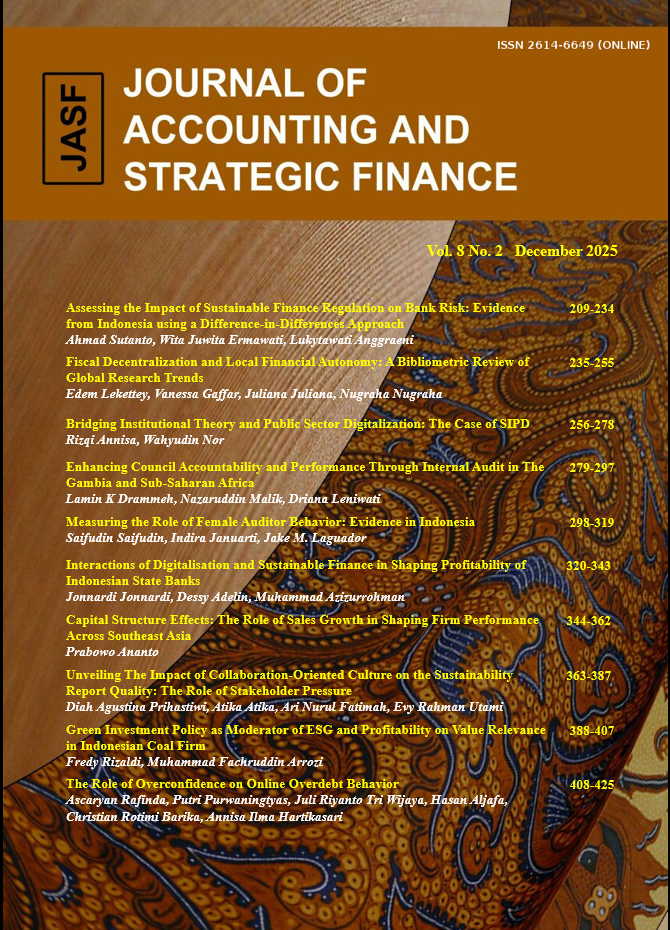
Bridging Institutional Theory and Public Sector Digitalization: The Case of SIPD
DOI:
https://doi.org/10.33005/jasf.v8i2.616Keywords:
SIPD (Sistem Informasi Pemerintahan Daerah), System Quality, Service Quality, Financial StatementsAbstract
Purpose: With this research, we want to better understand the opportunities and threats that local governments face as they work to integrate the Regional Government Information System (Sistem Informasi Pemerintahan Daerah/SIPD) for Accounting and Reporting.
Method: Participants included members the provincial administration to the regencies of Banjar, Barito Kuala, Hulu Sungai Tengah, Hulu Sungai Selatan, Hulu Sungai Utara, Tabalong, Tapin, and Banjarmasin city, also the Financial and Development Supervisory Agency (BPKP) and the Audit Board of the Republic of Indonesia (BPK RI) participated in a qualitative case study that covered all of South Kalimantan Province. Data were collected through interviews and documentation.
Findings: The research revealed a number of factors that challenge SIPD implementation, including concerns with the quality provided by systems and services, government format compliance with financial reports being less than 100%, data inaccuracies in its Administrative Module using system at both state and local levels, as well as technical problems also in the Administrative Module in delivering data to the Accounting and Reporting Module. Institutional theory describes that local governments persist in using SIPD despite existing constraints.
Novelty/Value: This study offers new insights into accounting and reporting challenges under SIPD from the perspective of local governments and oversight institutions, emphasizing the need for system reliability, user adaptation, and regulatory alignment to support effective public financial management, based on findings reflected in BPK audit results.
Downloads
References
Abdul Majid, J., Ab Rahim, N., & Razak, R. (2023). Institutional pressures, CEOs’ attributes, and strategic response towards climate change mitigation: The case of energy firms. Cogent Business and Management, 10(3). https://doi.org/10.1080/23311975.2023.2266166
Aidi, A., Avianti, I., Koeswayo, P. S., Poulus, S., & Mariam, S. (2024). The effect of an inclusive approach to collaborative governance and its impact on digitizing the quality of public services. Cogent Business and Management, 11(1). https://doi.org/10.1080/23311975.2024.2392324
ANTARA. (2025). BPK temukan tiga persoalan laporan keuangan pemda se-Kalsel. ANTARA KALSEL. https://kalsel.antaranews.com/berita/456881/bpk-temukan-tiga-persoalan-laporan-keuangan-pemda-se-kalsel
Ariyanto, D., Dewi, A. A., Paramadani, R. B., & Paramadina, A. A. (2024). Determinants of tax compliance and their impact on a sustainable information society: an investigation of MSMEs. Cogent Business and Management, 11(1). https://doi.org/10.1080/23311975.2024.2414856
Budiwitjaksono, G. S., Munari, M., & Suryaningrum, D. H. (2024). Critical Review of XBRL Financial Reporting: Perspective Pancasila as One of Indonesia’s National Defense Values. Journal of Accounting and Strategic Finance, 7(1), 181–199. https://doi.org/10.33005/jasf.v7i1.511
Chen, C., Choi, H. S., & Ractham, P. (2022). Data, attitudinal, and organizational determinants of big data analytics systems use. Cogent Business and Management, 9(1). https://doi.org/10.1080/23311975.2022.2043535
Creswell, J. W., & Creswell, J. D. (2023). Research design: Qualitative, quantitative, and mixed methods approach (6th ed.). SAGE Publications.
De Leon, M. V., Atienza, R. P., & Susilo, D. (2020). Influence of self-service technology (SST) service quality dimensions as a second-order factor on perceived value and customer satisfaction in a mobile banking application. Cogent Business and Management, 7(1). https://doi.org/10.1080/23311975.2020.1794241
Delone, W. H., & McLean, E. R. (2003). The DeLone and McLean Model of Information Systems Success: A Ten-Year Update. Journal of Management Information Systems, 19(4), 9–30. https://doi.org/10.1080/07421222.2003.1104574 8
DiMaggio, P. J., & Powell, W. W. (1983). The Iron Cage Revisited: Institutional Isomorphism and Collective Rationality in The Iron Cage Revisited: Institutional Isomorphism and Collective Rationality in Published by: American Sociological Association Stable. American Sociological Review, January 1983, 147–160. URL: http://www.jstor.org/stable/2.
Eriza, F., Nasution, N. F., & Thamrin, M. (2025). Natural Resource Management Through Digital Transformation Supporting Forestry Innovation 4.0 in North Sumatra. IOP Conference Series Earth and Environmental Science, 1445(1), 12110. https://doi.org/10.1088/1755-1315/1445/1/012110
Ferreira, A., & Santos, C. (2025). Digital Transformation in Public Sector. From: Enhancing Public Sector Accountability and Services Through Digital Innovation, 265–288. https://doi.org/10.4018/979-8-3693-9251-5.ch008
Gulden, M., Saltanat, K., Raigul, D., Dauren, T., & Assel, A. (2020). Quality management of higher education: Innovation approach from perspectives of institutionalism. An exploratory literature review. Cogent Business and Management, 7(1). https://doi.org/10.1080/23311975.2020.1749217
Hidayat Ur Rehman, I., Ali Turi, J., Rosak-Szyrocka, J., Alam, M. N., & Pilař, L. (2023). The role of awareness in appraising the success of E-government systems. Cogent Business and Management, 10(1). https://doi.org/10.1080/23311975.2023.2186739
Indriani, M., Nadirsyah, Fuadi, R., & Evayani. (2020). Can Siskeudes support village governance in Aceh Province of Indonesia? Cogent Business and Management, 7(1). https://doi.org/10.1080/23311975.2020.1743617
Iskandar, Y., Joeliaty, J., Kaltum, U., & Hilmiana, H. (2022). Systematic review of the barriers to social enterprise performance using an institutional framework. Cogent Business and Management, 9(1). https://doi.org/10.1080/23311975.2022.2124592
Krismajayanti, N. P. A., Darma, G. S., Mahyuni, L. P., & Martini, I. A. O. (2024). Drivers, Barriers and Key Success of Digital Transformation on SMEs: A Systematic Literature Review. Journal of Accounting and Strategic Finance, 7(1), 158–180. https://doi.org/10.33005/jasf.v7i1.505
Latifah, S. W., & Abitama, W. (2021). Keterlibatan Pemakai, Pelatihan dan Pendidikan, Serta Dukungan Manajemen Puncak Terhadap Kinerja Sistem Informasi Akuntansi. Journal of Accounting Science, 5(2), 123–139. https://doi.org/https://doi.org/10.21070/jas.v5i2.1332
Ly, B. (2024). Transforming commitment into performance: a study of digital transformation in the Cambodian public sector amidst a pandemic. Cogent Business and Management, 11(1). https://doi.org/10.1080/23311975.2024.2333609
Maria E, Halim A (2025). Institutional readiness and resistance to AI-based accounting platforms: evidence from Indonesian local governments. Transforming Government: People, Process and Policy, Vol. ahead-of-print No. ahead-of-print. https://doi.org/10.1108/TG-06-2025-0176
Maulana, R. Y., & Dečman, M. (2023). Collaborative Governance in the Digital Transformation Age: A Systematic Literature Review with Bibliometric Mapping. Central European Public Administration Review, 21(1), 31–60. https://doi.org/10.17573/cepar.2023.1.02
Mendes Junior, I. de J. A., & Alves, M. D. C. (2023). Evidence of neo-bureaucracy and institutional isomorphism in the implementation and functioning of the balanced scorecard: A case study. Cogent Business and Management, 10(1). https://doi.org/10.1080/23311975.2023.2176462
Menteri Dalam Negeri Republik Indonesia. (2019). Peraturan Menteri Dalam Negeri Republik Indonesia Nomor 70 Tahun 2019 tentang Sistem Informasi Pemerintah Daerah. Permendagri Republik Nomor 70, Nomor 65(879), 2004–2006.
Mokodompit, M. P., Subroto, B., Sutrisno, T., & Subekti, I. (2025). Isomorphic pressures and XBRL adoption: a meta-analysis with economic level as a moderator. Cogent Business and Management, 12(1). https://doi.org/10.1080/23311975.2024.2445783
Muda, P., Tornyeva, K., & MacCarthy, J. (2024). The moderating role of environmental factors between institutional isomorphic pressures and the adoption of IFRS for SMEs: application of SEM. Cogent Business and Management, 11(1). https://doi.org/10.1080/23311975.2024.2330012
Namatovu, A., & Kyambade, M. (2025). Assessing the Impact of Digital Leadership on Public Sector Performance: The Mediation Role of Digital Transformation in Developing Economies. Sage Open, 15(3). https://doi.org/10.1177/21582440251367585
Putri Pertiwi, I. F., Kusuma, H., Hadi, K., Arifin, J., Yoga, I., & Zakky Fahma, A. (2022). Isomorphism of integrated reporting’s sustainability embeddedness: evidence from Indonesian listed companies. Cogent Business and Management, 9(1). https://doi.org/10.1080/23311975.2022.2099605
SIPD V 1.1. (2023). Sistem Informasi Pemerintahan Daerah (SIPD). 1–70. https://satudata.cilacapkab.go.id/statistik-sektoral/102000000010000/dinas_kesehatan/data/79.u
Sofyani, H., Riyadh, H. A., & Fahlevi, H. (2020). Improving service quality, accountability and transparency of local government: The intervening role of information technology governance. Cogent Business and Management, 7(1). https://doi.org/10.1080/23311975.2020.1735690
Surya, S. B., Gurung, S. K., Jung Bahadur Rana, S. B., & Dhungana, B. R. (2024). e-Governance, citizen satisfaction and net benefits: the moderating effect of digital divide. Cogent Business and Management, 11(1). https://doi.org/10.1080/23311975.2024.2402512
Syamsiyah, K. N., Leniwati, D., & Affan, M. W. (2024). Digitalization Of Accounting: Accountant Profession in Facing Challenges of Era 5.0. Journal of Accounting and Strategic Finance, 7(2), 219–234. https://doi.org/10.33005/jasf.v7i2.444
Tran Thanh Thuy, N. (2025). Effect of accounting information system quality on decision-making success and non-financial performance: Does non-financial information quality matter? Cogent Business and Management, 12(1). https://doi.org/10.1080/23311975.2024.2447913
Wijaya, R. M. S. A. A., Yuhertiana, I., Sucahyati, D., Izaak, W. C., Susilowati, E., Suryaningrum, D. H., JASF, I. M. H., Sukiswo, H. W., Widodo, C., Wati, S. F. A., & Fitri, A. S. (2024). Innovations in Strategic Finance and Accounting: Insights from Research Centers in a VUCA Environment. Journal of Accounting and Strategic Finance, 7(2), 333–351. https://doi.org/10.33005/jasf.v7i2.529
Downloads
Published
How to Cite
Issue
Section
License
Copyright (c) 2025 Rizqi Annisa, Wahyudin Nor

This work is licensed under a Creative Commons Attribution 4.0 International License.