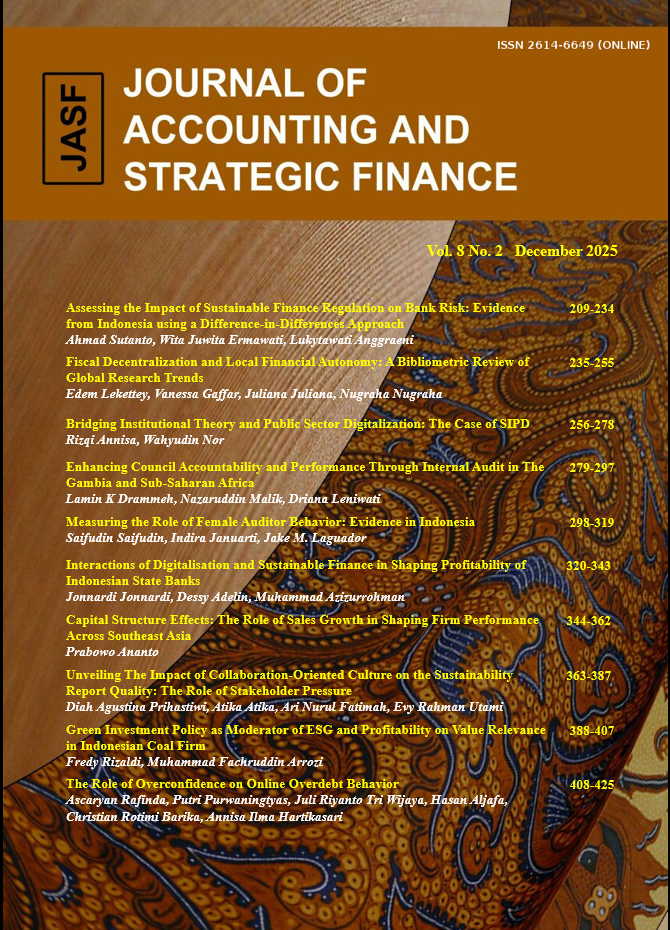
Capital Structure Effects: The Role of Sales Growth in Shaping Firm Performance Across Southeast Asia
DOI:
https://doi.org/10.33005/jasf.v8i2.645Keywords:
Capital structure, financial risks, firm performance, sales growth, trade-off theory, Southeast AsiaAbstract
Purpose: This study aims to explore the relationship between capital structure and firm performance among listed firms in Southeast Asia and examines whether sales growth changes that relationship, a topic in response to the lack of studies focused on this region.
Method: This study uses an unbalanced panel dataset of 4,229 listed firms in Southeast Asia, including Indonesia, Malaysia, the Philippines, Thailand, Singapore, and Vietnam from 2019 to 2023. The study employed panel data regression analysis with Stata 19.
Findings: The findings show important patterns in capital structure and performance. Leverage to equity consistently shows a negative relationship with ROA, ROE, and Tobin’s Q, indicating its detrimental effect on performance. Leverage to assets produces mixed results, while market value leverage is mostly positive. Sales growth plays a moderating role by strengthening the positive and significant impact of market value leverage on performance and reshapes other relationships. These results highlight the complexity of capital structure decisions and the influence of sales growth on capital structure and firm performance relationship in Southeast Asia
Implications: This research extends the trade-off theory by empirically showing that the optimal capital structure is a quantifiable result influenced by various leverage mechanisms. Sales growth becomes as a critical moderator, strengthening a firm’s ability to manage financial risk and shift the trade-off point toward more favorable leverage. This implies that capital structure does not remain fixed; it moves with growth expectations. Practically, firms with higher sales growth likely to adjust leverage when conditions change, which in turn reduces the likelihood of financial risks.
Novelty/Value: This research introduces a new perspective by examining sales growth as a moderating factor in the relationship between capital structure and firm performance. Additionally, by using multiple measures of performance (ROA, ROE, Tobin’S Q) and capital structure (LE, LA, MVL) in the context of emerging markets, the research offers insights that are both new and practical.
Downloads
References
Abdullah, H., & Tursoy, T. (2021). Capital structure and firm performance: Evidence of Germany under IFRS adoption. Review of Managerial Science, 15(2), 379–398. https://doi.org/10.1007/s11846-019-00344-5.
Ahmed, A. M., Nugraha, D. P., & Hágen, I. (2023). The Relationship between Capital Structure and Firm Performance: The Moderating Role of Agency Cost. Risks, 11(6), 102. https://doi.org/10.3390/risks11060102.
Al-Haddad, L. M., Saidat, Z., Seaman, C., & Gerged, A. M. (2024). Does capital structure matter? Evidence from family-owned firms in Jordan. Journal of Family Business Management, 14(1), 64–76. https://doi.org/10.1108/JFBM-09-2022-0115.
Ankamah-Yeboah, I., Nielsen, R., & Llorente, I. (2021). Capital structure and firm performance: Agency theory application to Mediterranean aquaculture firms. Aquaculture Economics & Management, 25(4), 367–387. https://doi.org/10.1080/13657305.2021.1976884.
Anwar, V., Irwan, A., Bin Mohd Zaini, M. N. D., Budi, R., & Tasrim. (2025). Behavioral Drivers of Capital Structure and Their Impact on MSE Performance: Evidence from Indonesia. JASF: Journal of Accounting and Strategic Finance, 8(1), 74–93. https://doi.org/10.33005/jasf.v8i1.561
Attia, E. F., Ezz Eldeen, H. H., & Daher, S. S. (2023). Size-Threshold Effect in the Capital Structure–Firm Performance Nexus in the MENA Region: A Dynamic Panel Threshold Regression Model. Risks, 11(2), 23. https://doi.org/10.3390/risks11020023.
Ayash, B., & Rastad, M. (2021). Leveraged buyouts and financial distress. Finance Research Letters, 38, 101452. https://doi.org/10.1016/j.frl.2020.101452.
Ayaz, M., Mohamed Zabri, S., & Ahmad, K. (2021). An empirical investigation on the impact of capital structure on firm performance: Evidence from Malaysia. Managerial Finance, 47(8), 1107–1127. https://doi.org/10.1108/MF-11-2019-0586.
Baltagi, B. H. (2021). Econometric Analysis of Panel Data. Cham: Springer International Publishing. https://doi.org/10.1007/978-3-030-53953-5.
Bawono, I. R., Handika, R., & Surya Rahmajati, E. (2025). How do firms’ characteristics affect risks? ASEAN firms panel data analysis. Cogent Business & Management, 12(1), 2436646. https://doi.org/10.1080/23311975.2024.2436646.
Brahmayanti, I. A. S. (2024). Revealing Corporate Value: The Role of Investment Decisions, Debt Policy, and Ownership Structure. JASF: Journal of Accounting and Strategic Finance, 7(2), 235–251. https://doi.org/10.33005/jasf.v7i2.493.
Bui, T. N., Nguyen, X. H., & Pham, K. T. (2023). The Effect of Capital Structure on Firm Value: A Study of Companies Listed on the Vietnamese Stock Market. International Journal of Financial Studies, 11(3), 100. https://doi.org/10.3390/ijfs11030100.
Candy, C., & Quinn, F. (2023). The Relationship Between Ownership Structure, Capital Structure, and Firm Performance: The Evidence from Indonesian Manufacturing Sector. Almana: Jurnal Manajemen dan Bisnis, 7(2), 369–382. https://doi.org/10.36555/almana.v7i2.2185.
Chang, C.-C., Kyi, S.-S., Yang, K.-S., & Wu, H.-P. (2025). Zero-leverage and firm performance – Evidence from Taiwan. Research in International Business and Finance, 73, 102656. https://doi.org/10.1016/j.ribaf.2024.102656.
Cheratian, I., Goltabar, S., Gholipour, H. F., & Farzanegan, M. R. (2024). Finance and sales growth at the firms level in Iran: Does type of spending matter? Research in International Business and Finance, 67, 102142. https://doi.org/10.1016/j.ribaf.2023.102142.
Dao, T. T. B., & Phan, M. C. (2023). Stakeholder theory, risk-taking, and firm performance. Corporate Governance: The International Journal of Business in Society, 23(7), 1623–1647. https://doi.org/10.1108/CG-09-2022-0366.
Dodoo, R. N. A., Kumi, M., & Mangudhla, T. (2023). The effect of capital structure on firm performance: Empirical evidence from emerging economy. EuroMed J. of Management, 5(1), 83. https://doi.org/10.1504/EMJM.2023.128241.
Ertugrul, M., & Coskun, A. (2021). What is a real measure of corporate liquidity. International Journal of Management and Economics, 57(1), 3–13. https://doi.org/10.2478/ijme-2021-0002.
Ferriswara, D., Sayidah, N., & Agus Buniarto, E. (2022). Do corporate governance, capital structure predict financial performance and firm value? (empirical study of Jakarta Islamic index). Cogent Business & Management, 9(1), 2147123. https://doi.org/10.1080/23311975.2022.2147123.
Frank, M. Z., & Goyal, V. K. (2009). Capital Structure Decisions: Which Factors Are Reliably Important? Financial Management, 38(1), 1–37. https://doi.org/10.1111/j.1755-053X.2009.01026.x.
Hair, J. F., Black, W. C., Babin, B. J., & Anderson, R. E. (2018). Multivariate Data Analysis (8th ed.). Cengage Learning.
Haque, S., & Varghese, R. (2023). Firms’ rollover risk, capital structure, and unequal exposure to aggregate shocks. Journal of Corporate Finance, 80, 102416. https://doi.org/10.1016/j.jcorpfin.2023.102416.
Ing, L. Y. (2024, February 12). ASEAN in the Global Economy: A Half-Century Journey. Economic Research Institute for ASEAN and East Asia. Retrieved from https://www.eria.org/news-and-views/asean-in-the-global-economy--a-half-century-journey.
Islam, Z. ul, & Iqbal, M. M. (2022). The Relationship Between Capital Structure and Firm Performance: New Evidence from Pakistan. The Journal of Asian Finance, Economics and Business, 9(2), 81–92. https://doi.org/10.13106/JAFEB.2022.VOL9.NO2.0081.
Kalash, I. (2023). The financial leverage–financial performance relationship in the emerging market of Turkey: The role of financial distress risk and currency crisis. EuroMed Journal of Business, 18(1), 1–20. https://doi.org/10.1108/EMJB-04-2021-0056.
Kraus, A., & Litzenberger, R. H. (1973). A State‐Preference Model of Optimal Financial Leverage. The Journal of Finance, 28(4), 911–922. https://doi.org/10.1111/j.1540-6261.1973.tb01415.x.
Lindset, S., Nygård, G., & Persson, S. (2024). Trade‐Off Theory for Dual Holders. Journal of Money, Credit and Banking, 56(7), 1611–1643. https://doi.org/10.1111/jmcb.13128.
Liwaul, L., Dali, N., & Sahrun, S. (2023). Evaluating Financial Health and Sustainability of Post-Merger Port Operations in Indonesia: Liquidity and Profitability Insights. JASF: Journal of Accounting and Strategic Finance, 6(2), 236–258. https://doi.org/10.33005/jasf.v6i2.466
Luu, D. H. (2021). The Impact of Capital Structure on Firm Value: A Case Study in Vietnam. The Journal of Asian Finance, Economics and Business, 8(5), 287–292. https://doi.org/10.13106/JAFEB.2021.VOL8.NO5.0287.
M N, N., Shenoy, S. S., Chakraborty, S., & B M, L. (2024). Does the Ind AS moderate the relationship between capital structure and firm performance? Journal of Corporate Accounting & Finance, 35(2), 86–102. https://doi.org/10.1002/jcaf.22673.
M. N., N., Shenoy, S. S., Chakraborty, S., & B. M., L. (2024). Is the nexus between capital structure and firm performance asymmetric? An emerging market perspective. Cogent Economics & Finance, 12(1), 2296195. https://doi.org/10.1080/23322039.2023.2296195.
Ma, P., Yuan, Q., & Xu, H. (2025). Optimal financing modes of a capital-constrained manufacturer under different sales strategies. Kybernetes, 54(3), 1554–1600. https://doi.org/10.1108/K-05-2023-0875.
Mathur, N., Tiwari, S. C., Sita Ramaiah, T., & Mathur, H. (2021). Capital structure, competitive intensity, and firm performance: An analysis of Indian pharmaceutical companies. Managerial Finance, 47(9), 1357–1382. https://doi.org/10.1108/MF-01-2020-0009.
Meishan Chua, Nazrul Hisyam Ab Razak, Annuar Md Nassir, & Mohamed Hisham Yahya. (2021). Speed of Adjustment towards Target Leverage in the ASEAN Countries. International Journal of Business and Society, 22(1), 313–331. https://doi.org/10.33736/ijbs.3177.2021.
Modigliani, F., & Miller, M. H. (1958). The cost of capital, corporation finance and the theory of investment. The American Economic Review, 48(3), 261–297. https://www.jstor.org/stable/1809766.
Modigliani, F., & Miller, M. H. (1963). Corporate income taxes and the cost of capital: A correction. The American Economic Review, 53(3). https://www.jstor.org/stable/1809167.
Myers, S. C. (1977). Determinants of corporate borrowing. Journal of Financial Economics, 5(2), 147–175. https://doi.org/10.1016/0304-405X(77)90015-0.
Nazir, A., Azam, M., & Khalid, M. U. (2021). Debt financing and firm performance: Empirical evidence from the Pakistan Stock Exchange. Asian Journal of Accounting Research, 6(3), 324–334. https://doi.org/10.1108/AJAR-03-2019-0019.
Neves, M. E., Proença, C., & Dias, A. (2020). Bank Profitability and Efficiency in Portugal and Spain: A Non-Linearity Approach. Journal of Risk and Financial Management, 13(11), 284. https://doi.org/10.3390/jrfm13110284.
Ngatno, Apriatni, E. P., & Youlianto, A. (2021). Moderating effects of corporate governance mechanism on the relation between capital structure and firm performance. Cogent Business & Management, 8(1), 1866822. https://doi.org/10.1080/23311975.2020.1866822.
Prabowo, A. (2023). The Severity of COVID-19 and Firm Market Value: How Does It Affect Firms? The Indonesian Journal of Accounting Research, 26(2), 229–248. https://doi.org/10.33312/ijar.687.
Qin, J. (2024). Application of Trade-off Theory in Real-Life Corporate Capital Structure Adjustments. Advances in Economics, Management and Political Sciences, 76(1), 88–93. https://doi.org/10.54254/2754-1169/76/20241901.
Rauf, F., Wanqiu, W., Naveed, K., Qadri, S. U., & Ali, M. S. E. (2023). How ESG reporting is affected by sustainable finance and green innovation: Moderating role of sales growth. Environmental Science and Pollution Research, 31(5), 7246–7263. https://doi.org/10.1007/s11356-023-31479-4.
Ronoowah, R. K., & Seetanah, B. (2023). The moderating and mediating effects of corporate governance and capital structure on firm performance: Empirical evidence from an emerging market. Managerial Finance, 49(9), 1377–1399. https://doi.org/10.1108/MF-08-2022-0382.
Ronoowah, R. K., & Seetanah, B. (2024). Capital structure and the firm performance nexus: The moderating and mediating roles of agency cost. Managerial Finance, 50(9), 1598–1621. https://doi.org/10.1108/MF-03-2024-0177.
Sdiq, S. R., & Abdullah, H. A. (2022). Examining the effect of agency cost on capital structure-financial performance nexus: Empirical evidence for emerging market. Cogent Economics & Finance, 10(1), 2148364. https://doi.org/10.1080/23322039.2022.2148364.
Sikveland, M., Xie, J., & Zhang, D. (2022). Determinants of capital structure in the hospitality industry: Impact of clustering and seasonality on debt and liquidity. International Journal of Hospitality Management, 102, 103172. https://doi.org/10.1016/j.ijhm.2022.103172.
Spitsin, V., Vukovic, D., Anokhin, S., & Spitsina, L. (2020). Company performance and optimal capital structure: Evidence of transition economy (Russia). Journal of Economic Studies, 48(2), 313–332. https://doi.org/10.1108/JES-09-2019-0444.
Spitsin, V., Vukovic, D. B., Spitsina, L., & Özer, M. (2022). The impact of high-tech companies’ performance and growth on capital structure. Competitiveness Review: An International Business Journal, 32(6), 975–994. https://doi.org/10.1108/CR-03-2021-0042.
Stock, J. H., & Watson, M. W. (2019). Introduction to Econometrics (4th ed.). Pearson.
Su, X., & Zheng, Y. (2025). Capital structure adjustment speed and legal environments: Evidence from SMEs. Finance Research Letters, 73, 106612. https://doi.org/10.1016/j.frl.2024.106612.
Tanko, U. M., Siyanbola, A. A., Bako, P. M., & Dotun, O. V. (2021). Capital Structure and Firm Financial Performance: Moderating Effect of Board Financial Literacy in Nigerian Listed Non-Financial Companies. Journal of Accounting Research, Organization and Economics, 4(1), 48–66. https://doi.org/10.24815/jaroe.v4i1.18322.
Tian, X., Wang, Y., & Kohar, U. H. A. (2024). Capital structure, business model innovation, and firm performance: Evidence from Chinese listed corporate based on system GMM model. PLOS ONE, 19(6), e0306054. https://doi.org/10.1371/journal.pone.0306054.
Ullah, A., Pinglu, C., Ullah, S., Zaman, M., & Hashmi, S. H. (2020). The nexus between capital structure, firm-specific factors, macroeconomic factors, and financial performance in the textile sector of Pakistan. Heliyon, 6(8), e04741. https://doi.org/10.1016/j.heliyon.2020.e04741.
Wang, Z., & Huang, Y. (2021). The Analysis of Capital Structure: Based on Two Hypothetical Firms. Presented at the 2021 3rd International Conference on Economic Management and Cultural Industry (ICEMCI 2021), Guangzhou, China. Guangzhou, China. https://doi.org/10.2991/assehr.k.211209.537.
Yoewono, H. (2024). Pengaruh Profitabilitas, Leverage, Earnings Per Share, dan Tax Planning Terhadap Return Saham. Owner, 8(2), 1451–1464. https://doi.org/10.33395/owner.v8i2.1961.
Downloads
Published
How to Cite
Issue
Section
License
Copyright (c) 2025 Ananto Prabowo

This work is licensed under a Creative Commons Attribution 4.0 International License.