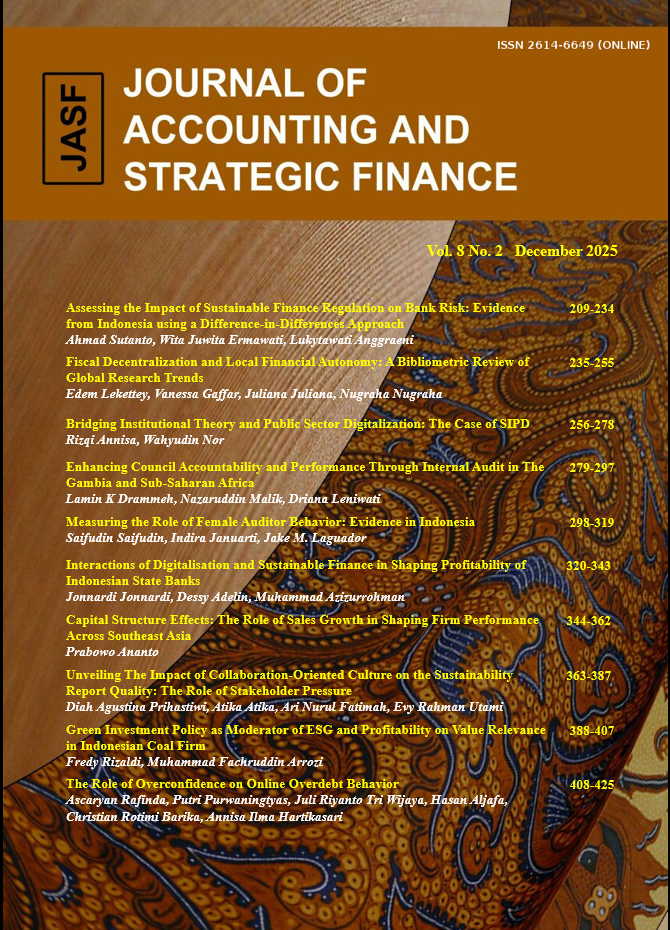
Interactions of Digitalisation and Sustainable Finance in Shaping Profitability of Indonesian State Banks
DOI:
https://doi.org/10.33005/jasf.v8i2.671Keywords:
bank performance, digital capability, developmental credit, sustainable finance, state-owned banksAbstract
Purpose: This study examines the determinants of financial performance in Indonesian state-owned and regionally owned banks by integrating prudential indicators with developmental, sustainability, and digital transformation variables. It evaluates how digital capability and green lending moderate the effects of credit risk, earning power, and developmental credit on profitability.
Method: The analysis uses balanced panel data from six banks over two thousand nineteen to two thousand twenty-three. A fixed effect panel regression model with interaction terms captures both direct determinants and moderating influences. Key predictors include nonperforming loans, net interest margin, developmental credit, and cooperative or village enterprise lending, while moderating variables comprise digital capability and green lending.
Findings: Nonperforming loans exert the strongest negative effect on profitability, whereas net interest margin remains the primary driver of return on assets. Developmental credit and lending to local enterprises enhance financial performance. Green lending and environmental, social, and governance performance are positively associated with profitability. Digital capability weakens the adverse influence of credit risk and strengthens the gains from earning power. Green lending amplifies the positive effect of developmental credit.
Implications: Profitability in state-aligned banks reflects the combined influence of prudential fundamentals, developmental mandates, sustainable finance initiatives, and digital transformation. Strengthening credit risk management, improving developmental programme mechanisms, expanding green finance, and deepening digital capability are essential for enhancing performance and informing regulatory incentive design.
Novelty/Value: This study offers integrated empirical evidence on prudential, developmental, sustainability, and digital determinants of profitability in Indonesian state banking. It demonstrates that digital capability and green lending not only improve financial outcomes but also reinforce the effectiveness of developmental credit, thereby advancing research on development-oriented and sustainable finance models.
Downloads
References
Abdeljawad, I., Rashid, M., Bahlaq, A., & Alia, M. A. (2025). Net interest margin in dual banking systems of the MENA region: Balancing profitability and social responsibility. Review of Financial Economics, 43(4), 477–496. https://doi.org/10.1002/rfe.70009
Abu Al-Haija, E., Al-Haraizah, A., Lataifeh, A. S., Meqdade, M., & Yousef, N. (2025). The impact of digital banking transformation (DBT) platforms on the profitability and efficiency of Islamic banking. Journal of Islamic Marketing. https://doi.org/10.1108/JIMA-06-2024-0241
Adam, L., Sarana, J., Suyatno, B., Soekarni, M., Suryanto, J., Ermawati, T., Saptia, Y., Adityawati, S., Mychelisda, E., Pamungkas, Y., Abdillah, M. R. N., Angelia, L., & Thoha, M. (2025). Driving Financial Inclusion in Indonesia with Innovative Credit Scoring. Journal of Risk and Financial Management, 18(8), 442. https://doi.org/10.3390/jrfm18080442
Alfhaili, F. A. (2025). Loan-to-deposit reform and deposit maturity: Evidence from Saudi Arabia. Cogent Economics & Finance, 13(1), 2562344. https://doi.org/10.1080/23322039.2025.2562344
Aninwagu, V., & Onyema, J. I. (2025). Financial Inclusion and Nigeria’s Economic Resilience (SSRN Scholarly Paper No. 5358921). Social Science Research Network. https://doi.org/10.2139/ssrn.5358921
Aqmala, D., Panjaitan, R., Ardyan, E., & Putra, F. I. F. S. (2025). The role of green blue ocean strategy in enhancing frugal innovation through IoT and AI: A resource-based view perspective. Journal of Entrepreneurship, Management and Innovation, 21(2), 56–81. https://doi.org/10.7341/20252124
Bernard Azolibe, C. (2022). Banking Sector Intermediation Development and Economic Growth: Evidence from Nigeria. Journal of African Business, 23(3), 757–774. https://doi.org/10.1080/15228916.2021.1926857
Bouteska, A., Harasheh, M., & Abedin, M. Z. (2023). Revisiting overconfidence in investment decision-making: Further evidence from the U.S. market. Research in International Business and Finance, 66, 102028. https://doi.org/10.1016/j.ribaf.2023.102028
Bui, C., Scheule, H., & Wu, E. (2020). A cautionary tale of two extremes: The provision of government liquidity support in the banking sector. Journal of Financial Stability, 51, 100784. https://doi.org/10.1016/j.jfs.2020.100784
Chung, C., Gibson, J., & Kim, B. (2010). CPI Mismeasurements and Their Impacts on Economic Management in Korea*. Asian Economic Papers, 9(1), 1–15. https://doi.org/10.1162/asep.2010.9.1.1
Dinka, S. T., & Asfaw, A. S. (2026). The impact of efficiency and income diversification on performance of commercial banks: Evidence from Sub-Saharan African countries. Cogent Business & Management, 13(1), 2597069. https://doi.org/10.1080/23311975.2025.2597069
Ferli, O., Lestari, D., & Kusumawardhani, L. I. I. (2022). Digital Products Increase Fee-based Income Banking in Indonesia. Jurnal Ilmu Manajemen dan Ekonomika, 15(1), 33–40. https://doi.org/10.35384/jime.v15i1.300.
Handoyo, S. (2024). Purchasing in the digital age: A meta-analytical perspective on trust, risk, security, and e-WOM in e-commerce. Heliyon, 10(8), e29714. https://doi.org/10.1016/j.heliyon.2024.e29714.
Handoyo, S., & Anas, S. (2024). The effect of environmental, social, and governance (ESG) on firm performance: The moderating role of country regulatory quality and government effectiveness in ASEAN. Cogent Business & Management, 11(1), 2371071. https://doi.org/10.1080/23311975.2024.2371071.
Hastuti, T., & Santoso, B. (2025). The Role of Insurance in Financial Risk Mitigation within the Banking Sector. International Journal of Accounting and Business Administration (IJABA), 1(1), 10-18. https://ecogreenjournals.com/ijaba/article/view/13
Indrawati, S. M., & Kuncoro, A. (2021). Improving Competitiveness Through Vocational and Higher Education: Indonesia’s Vision for Human Capital Development In 2019–2024. Bulletin of Indonesian Economic Studies, 57(1), 29–59. https://doi.org/10.1080/00074918.2021.1909692
Jović, Ž., & Nikolić, I. (2022). The Darker Side of Fintech: The Emergence of New Risks. Zagreb International Review of Economics & Business, 25(SCI), 46–63. https://doi.org/10.2478/zireb-2022-0024
Junarsin, E., Pelawi, R. Y., Kristanto, J., Marcelin, I., & Pelawi, J. B. (2023). Does fintech lending expansion disturb financial system stability? Evidence from Indonesia. Heliyon, 9(9), e18384. https://doi.org/10.1016/j.heliyon.2023.e18384.
Kanga, D., Loko, B., Agou, G., & Kpodar, K. R. (2024). Intra-African Migration: Exploring the Role of Human Development, Institutions, and Climate Shocks, IMF Working Papers 2024, 097 (2024). https://doi.org/10.5089/9798400276507.001
Kardiman, T. A., Yoga M. R., & Indriani, F. (2025). Digital Transformation Sustainability in Indonesia’s Banking Sector: A Systematic Review. Arthatama: Journal of Business Management and Accounting, 9(2), 258–277. Retrieved from https://journal.lifescifi.com/index.php/art/article/view/700.
Khamisu, M. S., Paluri, R. A., & Sonwaney, V. (2024). Environmental social and governance (ESG) disclosure motives for environmentally sensitive industry: An emerging economy perspective. Cogent Business & Management, 11(1), 2322027. https://doi.org/10.1080/23311975.2024.2322027.
Konstantakopoulou, I. (2023). Financial Intermediation, Economic Growth, and Business Cycles. Journal of Risk and Financial Management, 16(12). https://doi.org/10.3390/jrfm16120514.
Kusuma, A. R., Syarief, R., Sukmawati, A., & Ekananta, A. (2024). Factors influencing the digital transformation of sales organizations in Indonesia. Heliyon, 10(5), e27017. https://doi.org/10.1016/j.heliyon.2024.e27017.
Linggadjaya, R. I. T., Atahau, A. D. R., Ugut, G. S. S., & Suk, K. S. (2025). The Moderating Role of Capital Adequacy on Bank Specific Characteristics to Sustainable Growth: Evidence from Commercial Banks in Indonesia. SAGE Open, 15(3), 21582440251353042. https://doi.org/10.1177/21582440251353042.
Liu, Z., Xie, Y., Yang, J., & Zhu, D. (2024). Credit Cooperatives and Income Growth: Analyzing the Role of Financial Sustainability. Discrete Dynamics in Nature and Society, 2024(1), 9263896. https://doi.org/10.1155/2024/9263896.
Loizos, K. (2023). Prolegomena to an Evolutionary Theory of Development Banking for a Sustainable Future. Journal of Economic Issues, 57(2), 606–612. https://doi.org/10.1080/00213624.2023.2202561.
Mitzinneck, B. C., Coenen, J., Noseleit, F., & Rupietta, C. (2024). Impact creation approaches of community-based enterprises: A configurational analysis of enabling conditions. Journal of Business Venturing, 39(6), 106420. https://doi.org/10.1016/j.jbusvent.2024.106420.
Mohammad, W. M. W., & Wasiuzzaman, S. (2021). Environmental, Social and Governance (ESG) disclosure, competitive advantage and performance of firms in Malaysia. Cleaner Environmental Systems, 2, 100015. https://doi.org/10.1016/j.cesys.2021.100015.
Mouti, K., Kilincarslan, E., & Li, J. (2025). Environmental Credit Risk, Climate Change and Bank Performance: Evidence from a Global Panel of Banks. Business Strategy and the Environment, bse.70259. https://doi.org/10.1002/bse.70259.
Mtenga, R. P., Funga, A., & Kadigi, M. (2024). Participation in village savings and lending associations and rice profitability in Tanzania: Application of propensity score matching and endogenous switching regression. Sustainable Futures, 7, 100169. https://doi.org/10.1016/j.sftr.2024.100169.
Naili, M., & Lahrichi, Y. (2022). Banks’ credit risk, systematic determinants and specific factors: Recent evidence from emerging markets. Heliyon, 8(2), e08960. https://doi.org/10.1016/j.heliyon.2022.e08960.
Ngo, H. K., & Trinh, H. T. T. (2025). The impact of financial risks on bank performance: Evidence from Bayesian analysis in Vietnam’s commercial banks. Discover Sustainability, 6(1), 515. https://doi.org/10.1007/s43621-025-01246-1.
Nocco, B. W., & Stulz, R. M. (2022). Enterprise Risk Management: Theory and Practice. Journal of Applied Corporate Finance, 34(1), 81–94. https://doi.org/10.1111/jacf.12490.
Nurfitriani, N., & Latif, I. N. (2025). Sustainable Capital Budgeting: Assessing Long-Term Effects Beyond Profitability. Journal of Accounting and Strategic Finance, 8(1), 133–151. https://doi.org/10.33005/jasf.v8i1.581.
Nurwulandari, A., Hasanudin, H., Subiyanto, B., & Pratiwi, Y. C. (2022). Risk Based bank rating and financial performance of Indonesian commercial banks with GCG as intervening variable. Cogent Economics & Finance, 10(1), 2127486. https://doi.org/10.1080/23322039.2022.2127486.
Ong, H.-B., Wasiuzzaman, S., Chong, L.-L., & Choon, S.-W. (2023). Digitalisation and financial inclusion of lower middle-income ASEAN. Heliyon, 9(2), e13347. https://doi.org/10.1016/j.heliyon.2023.e13347.
Ong, S. Y. Y., Habidin, N. F., Mohd Fuzi, N., Salleh, M. I., Ramdan, M. R., Abdullah, K., & Taasim, S. I. (2021). The Relationship between Live Commerce towards Customer Engagement in Malaysia E-commerce Platform. International Journal of Academic Research in Business and Social Sciences, 11(17), Pages 285-294. https://doi.org/10.6007/IJARBSS/v11-i17/11416.
Pape, F. (2022). Governing Global Liquidity: Federal Reserve Swap Lines and the International Dimension of US Monetary Policy. New Political Economy, 27(3), 455–472. https://doi.org/10.1080/13563467.2021.1967912.
Podder, B., & Ghosh, J. (2025). Digital transformation: How it impacts bank performance for emerging economies. International Journal of Emerging Markets, 1–21. https://doi.org/10.1108/IJOEM-05-2025-1108.
Rahman, Md. H., Rahman, J., Tanchangya, T., & Esquivias, M. A. (2023). Green banking initiatives and sustainability: A comparative analysis between Bangladesh and India. Research in Globalization, 7, 100184. https://doi.org/10.1016/j.resglo.2023.100184.
Rahmania, T., Wulandari, S. S., & Marfu, A. (2024). Sustainable financial institution in Indonesia: An empirical analysis of social-cultural context, nepotism, and moral hazard on the shaping of non-performing loans. Sustainable Futures, 8, 100279. https://doi.org/10.1016/j.sftr.2024.100279.
Saleh, I., & Abu Afifa, M. (2020). The effect of credit risk, liquidity risk and bank capital on bank profitability: Evidence from an emerging market. Cogent Economics & Finance, 8(1), 1814509. https://doi.org/10.1080/23322039.2020.1814509.
Sulfiana, S. (2025). Driving Agricultural Productivity in Indonesia: The Impact of Digital Transformation and Regional Disparities. Global Review of Tourism and Social Sciences, 1(2), 172–181. https://doi.org/10.53893/grtss.v1i2.367.
Sutrisno, S., Widarjono, A., & Hakim, A. (2024). The Role of Green Credit in Bank Profitability and Stability: A Case Study on Green Banking in Indonesia. Risks, 12(12), 198. https://doi.org/10.3390/risks12120198.
Tajuddin, I., & Kessi, A. M. F. (2025). Fiscal Decentralization and Regional Economic Growth: The Contrasting Effects of PAD and DAK in Gowa Regency, South Sulawesi. Amkop Management Accounting Review (AMAR), 5(2), 970–981. https://doi.org/10.37531/amar.v5i2.3055.
Verhoef, P. C., Broekhuizen, T., Bart, Y., Bhattacharya, A., Qi Dong, J., Fabian, N., & Haenlein, M. (2021). Digital transformation: A multidisciplinary reflection and research agenda. Journal of Business Research, 122, 889–901. https://doi.org/10.1016/j.jbusres.2019.09.022.
Wang, H., Zheng, L. J., Xu, X., & Hung, T. H. B. (2022). Impact of Financial Digitalization on Organizational Performance: A Look at the Dark Side. Journal of Global Information Management, 30(1), 1–35. https://doi.org/10.4018/JGIM.301602.
Wasiaturrahma, Sukmana, R., Ajija, S. R., Salama, S. C. U., & Hudaifah, A. (2020). Financial performance of rural banks in Indonesia: A two-stage DEA approach. Heliyon, 6(7), e04390. https://doi.org/10.1016/j.heliyon.2020.e04390.
Wasiaturrahma, W., Sulistyowati, C., Heriyati, D., & Ajija, S. R. (2020). Peningkatan Kinerja Koperasi Melalui Pendampingan Manajemen Keuangan Pada Koperasi 64 Bahari Surabaya. Jurnal Berdaya Mandiri, 2(1), 256–267. https://doi.org/10.31316/jbm.v2i1.354.
Downloads
Published
How to Cite
Issue
Section
License
Copyright (c) 2025 Jonnardi Jonnardi, Dessy Adelin, Muhammad Azizurrohman

This work is licensed under a Creative Commons Attribution 4.0 International License.